Software-Development
Technical Debt Audit: When to Refactor Legacy Code vs. Building a New Digital Core
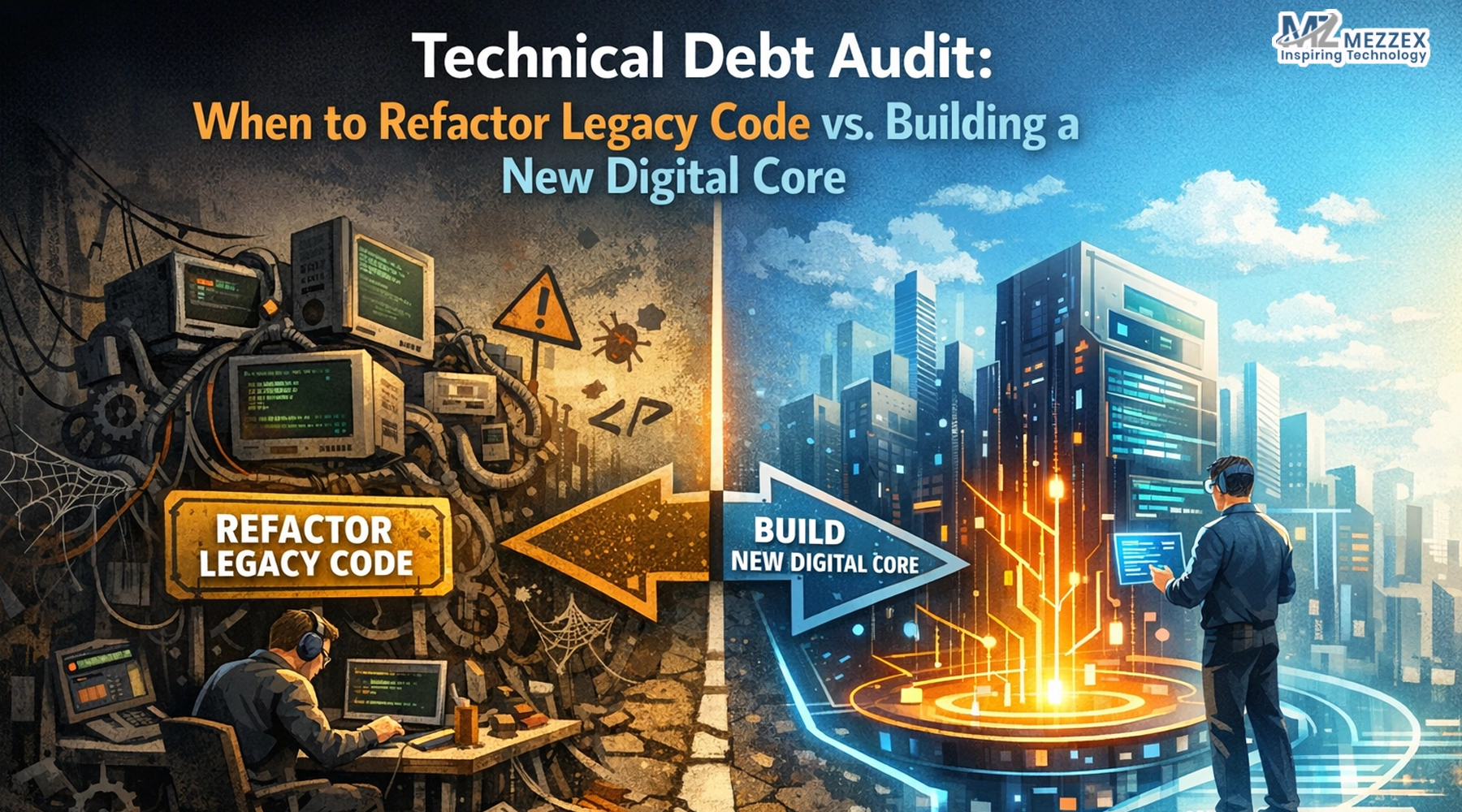
Technical debt functions as a silent tax on innovation. It accumulates when teams prioritise immediate delivery over long-term structural health. This debt creates a rigid environment, preventing scalability and increasing operational costs. Identifying the exact point where maintenance becomes more expensive than replacement requires a rigorous technical debt audit. This process evaluates code quality, performance bottlenecks, and business alignment. Deciding whether to refactor legacy code or build a new digital core is a strategic choice. Our approach ensures your technology matches your growth. We help you navigate this transition to maintain agility in a competitive market.
The Anatomy of a Technical Debt Audit
A technical debt audit provides a clear view of the structural integrity of your software. We examine the codebase to identify where shortcuts lead to long-term inefficiencies. This evaluation allows stakeholders to quantify the risk associated with existing systems. A thorough audit prevents unexpected system failures and provides a roadmap for modernisation. We focus on the following technical indicators to assess the health of your digital infrastructure.
- Static code analysis identifies high cyclomatic complexity that makes logic difficult to modify.
- Automated health metrics uncover "code smells" such as long methods and bloated classes requiring immediate attention.
- Security vulnerability scanning highlights outdated libraries and insecure data handling protocols.
- Dependency mapping reveals risks within third-party libraries needing urgent patches or replacement.
- Performance benchmarking tracks response times and resource consumption across all critical modules.
- Resource efficiency analysis pinpoints specific bottlenecks slowing down the end-user experience.
- Documentation review identifies knowledge gaps where logic depends on the tribal knowledge of a few individuals.
- Operational risk assessment quantifies the danger of system failure during future updates or personnel changes.
- Business logic alignment confirms if the code still supports primary goals or hinders daily operations.
- Workflow analysis detects where outdated logic forces employees to use manual workarounds outside the system.
- Maintenance cost tracking calculates the percentage of the budget spent on fixing bugs versus building new features.
- Innovation ratio analysis justifies the financial need for a major architectural intervention.
The Case for Refactoring: Surgical Modernisation
Refactoring allows us to improve the internal structure of the software without altering its external behaviour. This surgical approach is ideal when the core business logic remains valid but requires optimisation. We use refactoring to reduce complexity and improve the maintainability of the codebase. It provides a cost-effective way to extend the lifespan of an existing application. This method is particularly useful for organisations needing rapid improvements with minimal disruption.
- Refactoring is the most efficient path when the primary business logic remains accurate and effective.
- Surgical updates focus on improving the internal structure to make future feature additions easier.
- Modular system design permits developers to isolate specific sections for performance improvements.
- Targeted updates minimise the risk of disruption to the rest of the application.
- UI/UX modernisation improves user satisfaction without the risks associated with a full database migration.
- Front-end redesign provides a modern experience at a significantly lower cost than a total rebuild.
- Incremental ROI requirements make refactoring suitable for phased delivery over several months.
- Phased updates deliver immediate value to stakeholders without waiting for long development cycles.
- Platform compatibility updates ensure legacy code runs efficiently on modern cloud environments.
- API wrapping extends the lifespan of the current system by making it accessible to modern tools.
- Budget constraints favour refactoring for businesses needing to improve stability while maintaining current operations.
- Rapid improvement cycles provide a faster time-to-market for tactical software upgrades.
The Case for a New Digital Core: Strategic Rebirth
Building a new digital core is a strategic investment in the future of the organisation. This greenfield approach is necessary when the existing architecture reaches a technical ceiling. A new core allows us to implement modern technologies like AI integration and real-time data processing. It removes the constraints of outdated frameworks and provides a scalable foundation for growth. We recommend this path when the cost of maintaining legacy systems exceeds the value they provide.
- Architectural obsolescence occurs when the original framework cannot support modern integration requirements.
- Technical ceilings prevent the implementation of essential features like real-time data streaming or AI.
- The "cost of change" curve indicates when adding features to legacy code becomes more expensive than a rebuild.
- Financial analysis ensures you invest resources where they generate the maximum long-term value.
- Cloud-native architecture allows the new digital core to scale automatically based on user demand.
- Infrastructure modernisation ensures the system grows alongside your expanding customer base.
- Security by design meets current regulatory standards like GDPR or SOC2 from the outset.
- Deep-rooted failure points are eliminated by building a secure foundation that patches cannot provide.
- Strategic business shifts require a clean slate to implement modern business rules.
- Logical alignment ensures the new technology matches the current direction of the company.
- Modern tech stacks help recruit and retain the best technical talent in the industry.
- Developer retention improves when teams no longer need to maintain "dead" or obsolete languages.
- API-first design ensures seamless integration with the global ecosystem of third-party services.
Evaluating the Economic Impact: ROI and TCO
Understanding the financial implications of technical debt is essential for informed decision-making. We distinguish between the "principal"—the cost of the rebuild—and the "interest"—the ongoing cost of maintenance. High technical debt diverts funds away from innovation and growth. A rigorous economic evaluation helps stakeholders understand the long-term Total Cost of Ownership (TCO). We use these metrics to build a compelling business case for modernisation.
- Technical debt represents the implied cost of rework caused by choosing short-term solutions.
- Financial drain analysis compares the cost of maintaining outdated systems against the cost of innovation.
- Agility bottlenecks prevent businesses from responding quickly to sudden market shifts.
- Rigid environments lead to slower delivery cycles and a loss of competitive market share.
- Compliance risks in legacy systems lead to significant financial penalties and regulatory fines.
- Risk quantification justifies the initial investment required for a new digital core.
- Talent retention challenges increase recruitment costs when developers leave due to outdated tech stacks.
- Burnout reduction occurs when teams focus on building new features rather than constant firefighting.
- Operational overhead decreases as automated processes replace manual patches and workarounds.
- Hidden maintenance costs are revealed through a comprehensive audit of daily developer activities.
- Reducing the Total Cost of Ownership (TCO) is the primary goal of a five-year modernisation plan.
- Capital allocation improves when funds move from legacy support to strategic growth initiatives.
The Mezzex Modernisation Framework
The Mezzex framework provides a structured path for software evolution. We combine deep business analysis with technical expertise to deliver reliable results. Our process ensures that modernisation efforts align with your specific operational requirements. We prioritise data integrity and seamless transitions to minimise business downtime. This framework supports both refactoring and the creation of new digital cores.
- Deep business analysis maps your long-term goals to specific technical requirements.
- Requirement mapping ensures the chosen solution supports your revenue and growth targets.
- Prototyping allows stakeholders to verify performance and usability before a full commitment.
- Facsimile systems reduce the risk of building features that users do not actually need.
- QA-led migration strategy ensures that all data remains intact during the system transition.
- Automated test suites verify every data point to promote high standards for the new solution.
- Launch management focuses on servers or cloud platforms to ensure a hassle-free transition.
- Seamless software deployment minimises downtime for both your staff and your customers.
- Blue-green deployments allow for instant rollbacks to protect the business if issues arise.
- Long-term support protocols prevent the immediate accumulation of new technical debt.
- Ongoing optimisation keeps the system running at peak efficiency as your needs evolve.
- Legacy application redesign provides a balanced approach for those choosing the refactoring path.
STRATEGIC SOFTWARE MODERNISATION WITH MEZZEX
Optimising technical infrastructure requires a professional approach to legacy systems and new builds. At Mezzex, we provide software development services to solve the logistical challenges of modern digital operations. From legacy application redesign that improves performance to custom software development for a scalable new core, we focus on architectural integrity. Our developers use the latest technologies and a proven delivery framework to offer the reliability required for a resilient business. We believe professional-grade software solutions need to be accessible to everyone, helping you maintain an efficient routine. Explore our software, web, and app development essentials today to find reliable solutions for your business. Call +44 121-6616357 to discuss your technical debt audit.