Ecommerce-services
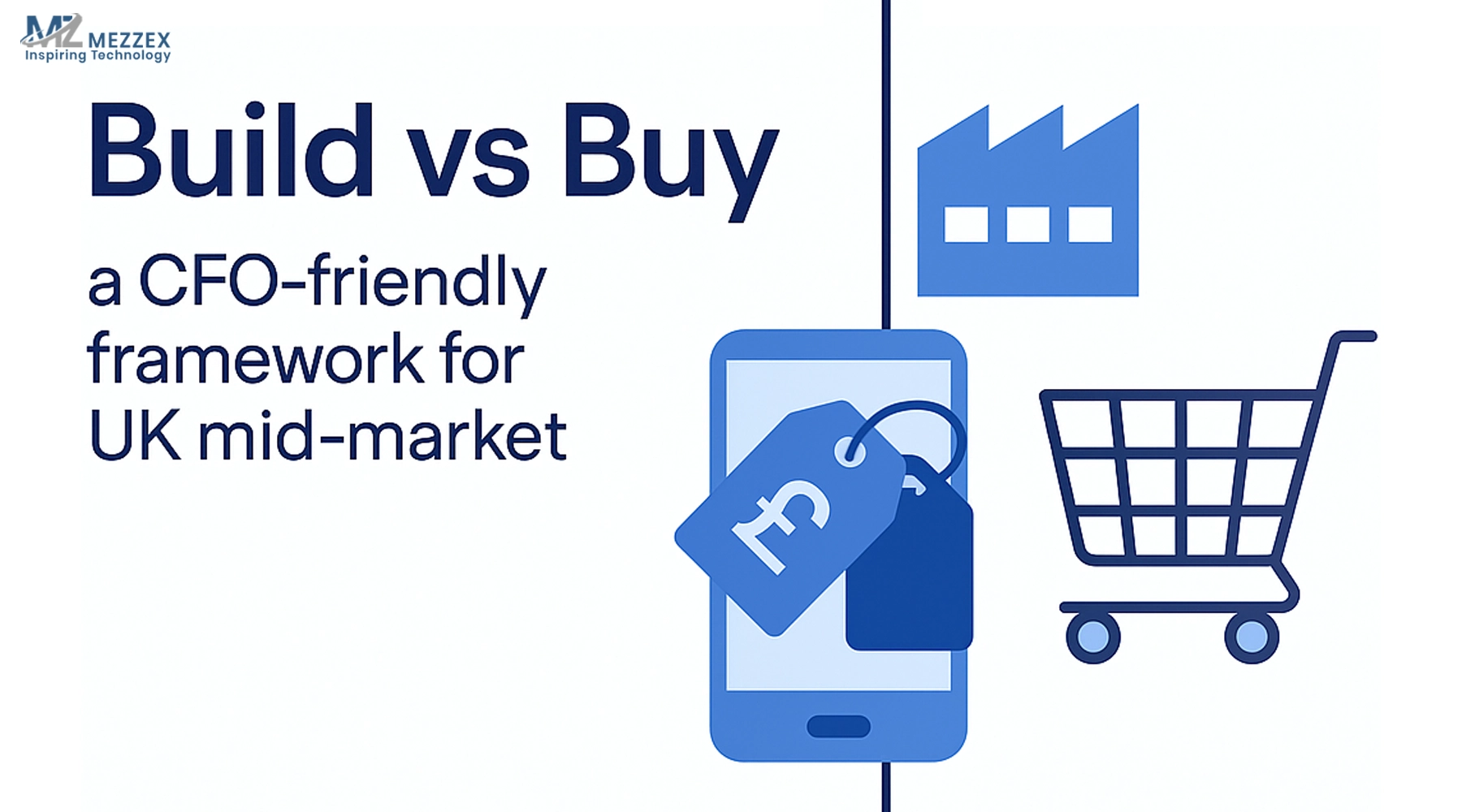
Build vs Buy: A CFO‑Friendly Framework for UK Mid‑Market
A UK mid‑market CFO faces the build vs buy question many times: new finance system, data platform, warehouse software, or customer app. Each decision affects cash flow, risk, and the rate of business growth. A rushed choice can drain the budget or lock the company into tools that do not fit. A clear build vs. buy framework provides the CFO with a repeatable way to compare options and explain the logic to the board. This blog outlines a straightforward, CFO-friendly structure that enables UK mid-market firms to assess cost, control, risk, and capacity in a step-by-step manner.
Define the build vs buy decision clearly
- Write down the business problem in one short sentence, not the solution. For example, “We need one view of orders across all sales channels,” not “We need to build a new order system.”
- State the scope: which teams the decision touches, which processes change, and which systems connect. This prevents scope creep when you compare build vs buy options.
- List hard constraints: budget range, target go‑live window, and any non‑negotiable rules from the board or regulators.
- Confirm if the capability sits close to your core advantage. If it supports what makes you different in the UK market, build gains more weight. If it sits in a common area like email or payroll, buy gains more weight.
- Note who owns the outcome: the CFO, CTO, COO, or a joint group. Clear ownership keeps the framework honest and stops decisions drifting between functions.
Run a financial assessment of lifecycle costs and ROI
- List all build costs: discovery, design, development, testing, licences, infrastructure, and ongoing support. Include internal staff time as a real cost, not a free resource.
- List all buy costs: setup, licences or subscriptions, integration, training, and vendor support. Include likely price steps as you add users or features.
- Map cash flows over three to five years for both routes. Use the same horizon for each option so you compare like with like.
- Add “hidden” costs, such as downtime risk, technical debt from rushed build work, or upgrade fees from vendors. These often change the answer in mid‑market organisations.
- Estimate financial benefits: revenue lift, margin improvement, or cost savings. Use ranges rather than a single number and link each benefit to a clear driver.
- Compare payback periods and net value, not just headline price. A more expensive option that unlocks faster growth or lower churn may still win for a UK mid‑market CFO.
Weigh control and flexibility
- Score how much control you need over features, roadmap, and data. Core processes or sensitive customer logic usually need more control and favour a build or heavily customised route.
- Check how much flexibility standard products offer through configuration, APIs, or modules. Many SaaS tools cover 80% of needs and leave room for light custom work on top.
- Ask if you need to own the IP to protect valuation or exit plans. In some mid‑market sectors, owning core platforms changes how investors see the business.
- Consider how often your process changes. If your teams change workflow every quarter, a rigid off‑the‑shelf tool may slow them down.
- Balance these points against the effort to design and maintain your own stack. The CFO framework keeps control in view, but ties it back to cost and risk rather than emotion.
Assess risk and compliance in a UK context
- List the main risks for each path: delivery risk, vendor risk, security risk, and change risk for staff. Give each a simple high, medium, or low rating.
- Map regulatory needs such as UK GDPR, sector rules, and audit demands. Check how each option supports evidence, reporting, and data lineage.
- For build, confirm you have in‑house security and compliance skills to design, test, and maintain the solution. If not, add the cost of external support to your model.
- For buy, review vendor terms for data hosting, breach response, uptime, and exit. A low licence price does not offset weak control of critical data.
- Consider concentration risk: if you buy from one vendor for several functions, note what happens if that partner fails or changes direction.
- Add a short risk narrative to your build vs buy summary, so the board sees financial and risk logic in one view.
Check resources and execution feasibility
- List internal skills across product, engineering, data, and change. A build vs buy framework only works if it reflects real capacity, not hoped‑for hires.
- Measure current project load. If teams already run several critical projects, a full build may slip, and the cost model may no longer hold.
- Check how fast the business needs the capability. If the market moves now, buy or partner often makes more sense for UK mid‑market firms.
- Consider hybrid options: buy a strong platform, then build light services or integrations around it. This often suits companies that need to speed now and have more control later.
- Factor in change management: training, support, and communication. An option that “wins” on paper but fails in adoption still wastes capital.
Use a simple build vs buy scorecard
- Create a one‑page scorecard with 4–5 criteria: lifecycle cost, control, risk and compliance, speed, and internal capacity.
- Score each option from 1 to 5 on each criterion, where 1 means “very weak” and 5 means “very strong” against your needs.
- Weight criteria if needed. For example, a CFO in a regulated UK mid‑market firm may give heavier weight to compliance and risk than to speed.
- Add brief notes under each score. Numbers alone do not tell the story; comments capture the “why” behind each rating.
- Use the scorecard in a joint session with finance, tech, and operations. The aim is not a perfect number; the aim is a shared, transparent view of trade‑offs.
Apply the framework: a short UK example
- A UK mid‑market retailer wants a new order management system that links web, marketplace, and warehouse channels.
- Build option: in‑house team designs and develops a system with full control over logic and reporting, but needs new hires and a long lead time.
- Buy option: the CFO and CTO shortlist SaaS order platforms that support UK tax rules, marketplace integrations, and warehouse links out of the box.
- The CFO runs the lifecycle cost model and sees that build needs higher upfront spend and longer payback, while buy spreads cost but needs strong vendor oversight.
- The team uses the scorecard, weights compliance and speed higher, and sees buy plus targeted custom integrations score best overall.
- The board sees a clear view of cost, control, risk, and capacity, and understands why the decision supports both growth and governance.
Map your build vs buy decision with Mezzex
Take control of your technology decisions with Mezzex, your trusted UK partner for mid‑market IT solutions. Whether you choose to build, buy, or blend options, we help you design and deliver systems that meet compliance, budget, and growth needs with confidence. Call Mezzex today at +44 121 661 6357 or email us at [email protected] to schedule a consultation. Visit our service page to explore how our expert teams deliver tailored web, software, app development, and digital marketing services to UK mid‑market businesses like yours. Start your data-driven journey now.