Software-Development
CI/CD for Small Teams: Ship Faster Without Breaking Production
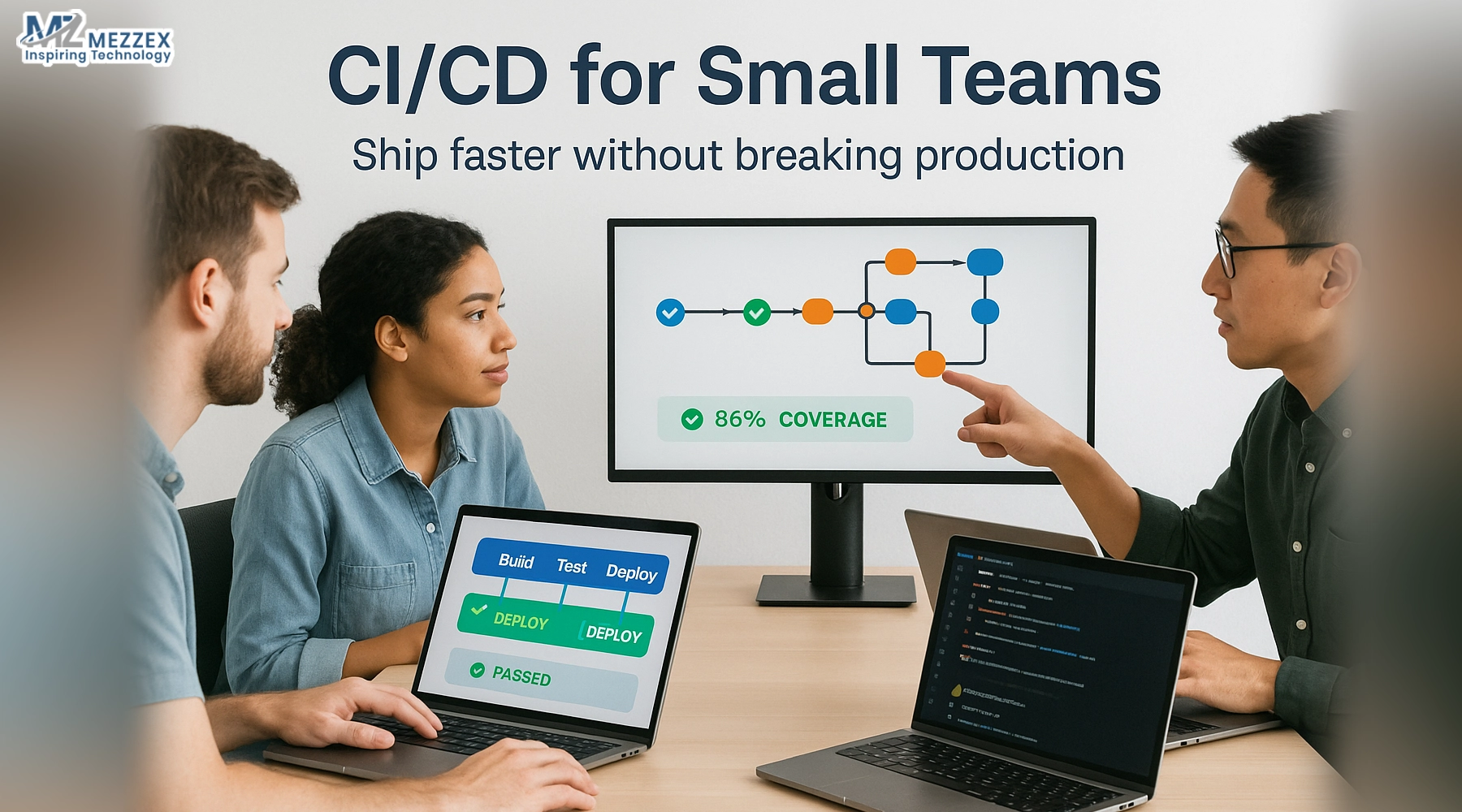
Your small dev team ships features, fixes bugs, and supports users at the same time, so release day often feels risky. Branches stack up, reviews slip, and one bad deploy can wipe out a whole sprint. Continuous integration and continuous delivery (CI/CD) give you a way to ship faster without turning every release into a gamble. You automate builds, tests, and deployments, so you catch issues early instead of fixing them live in production. With the right CI/CD pipeline, a 3–5 person team deploys many times a week with less stress and more control.
Why CI/CD suits small teams
Remove slow manual steps
- CI/CD replaces ad‑hoc builds, copy‑paste deploy scripts, and chat‑based checklists with one repeatable pipeline that runs on every change.
- This cuts human error and lets developers focus on writing and reviewing code instead of managing release admin.
Find problems early
- Continuous integration runs builds and tests on each commit or pull request, so you see broken changes within minutes, not days.
- Small teams fix issues at the source, while the context is still fresh, which keeps the main branch stable.
Keep releases small and safe
- CI encourages frequent, small merges, so each deployment carries less risk and is easier to roll back.
- Continuous delivery pushes every green build to a staging environment that mirrors production, so you review real behaviour before you release.
Match Mezzex’s engineering‑led quality
- Mezzex already delivers web, mobile, and software projects with CI/CD pipelines, test‑driven workflows, and structured deployment strategies.
- When your team follows similar patterns, Mezzex can plug into your stack and help you scale delivery without breaking production.
Design a simple CI pipeline for a 3–5 person team
Standardise your branching model
- Use boot‑based development or short‑lived feature branches that merge into main at least a few times per week.
- Keep branches small so merges stay clean and your pipeline finishes in under 10–15 minutes.
Hook your repo into CI
- Connect GitHub, GitLab, Bitbucket, or Azure DevOps to a CI service and trigger the pipeline on every push to main and on each pull request.
- Use one shared build script (for example, npm test, dotnet test, or pytest) so local and CI runs behave the same.
Start with a minimal, fast pipeline
- Define clear stages: checkout, install dependencies, build, run unit tests, publish artefact.
- Aim to keep this core pipeline fast; if runtime grows beyond 15 minutes, split tests into parallel jobs or introduce a nightly extended suite.
Protect the main with status checks
- Block merges if the CI job fails; the team treats a red pipeline as a stop sign and fixes it before anyone adds more features.
- Make pipeline status visible in pull requests and team chat, so everyone sees when quality slips.
Add automated tests that protect production
Prioritise fast, focused unit tests
- Cover core business logic with unit tests that finish in seconds, not minutes, so they run on every push without slowing the team.
- Target high‑risk modules first (billing, ordering, authentication) before low‑value helpers.
Add a lean integration test layer
- Create a small suite that hits key dependencies (databases, message queues, external APIs or test doubles) in a separate CI stage.
- Run these integration tests on main and before deployments, not necessarily on every feature branch if they are slower.
Use smoke tests on each deploy
- Define 5–15 smoke tests that check key user flows, such as sign‑in, dashboard load, or a simple transaction.
- Run smoke tests automatically after each deployment to staging and production, and fail the deployment if they do not pass.
Eliminate flaky tests
- Treat any flaky test as a defect: either fix its timing and data issues or quarantine it so it does not block reliable CI runs.
- Small teams cannot afford pipelines that randomly fail; trust in CI is as important as coverage.
Make continuous delivery safe for small teams
Mirror production in staging
- Keep the same runtime, configuration style, and main services in staging as in production, so behaviour matches.
- Avoid “staging‑only” hacks in code; use configuration flags instead.
Automate staging deployments
- Configure CD so every green build on main goes to staging without manual steps, which keeps that environment current.
- Run automatic smoke tests right after each staging deploy, then do short manual checks on new or risky features.
Use rollout patterns that reduce risk
- For user‑facing changes, start with canary releases where a small percentage of traffic hits the new version while you watch error and latency metrics.
- For core services, use blue‑green deployments so you switch all traffic only when the new version passes checks.
Keep rollback ready
- Store previous build artefacts and database migration strategies so you can revert with one command or one click if production degrades.
- Practise rollback in staging at least once a quarter, so the team knows the steps under pressure.
Add simple approvals
- Require at least one peer code review and one release approval for production deployments, even in very small teams.
- Define who has the authority to approve emergency hotfixes and how you document them.
Keep your CI/CD pipeline lean and observable
Track a small set of key metrics
- Monitor build time, queue time, failure rate, mean time to repair (MTTR), and deployment frequency.
- Review these metrics in team retros and set simple goals, such as keeping average build time under 10 minutes.
Avoid pipeline bloat
- Remove old stages that nobody owns or understands, and keep the pipeline definition in version control with a short README.
- If you add a new check, decide in advance when you review its value and remove it if it does not help.
Make failures visible and actionable
- Send notifications for failed builds, failed tests, and failed deployments to the team channel you use daily.
- Include direct links to logs and artefacts so the first responder can diagnose quickly.
Share ownership across the team
- Avoid having a single “CI person”; expect every developer to understand the pipeline basics and fix their own broken builds.
- Review the pipeline monthly and let developers suggest improvements as part of normal backlog grooming.
How Mezzex supports CI/CD for small teams
Build CI/CD into projects from day one
- Mezzex delivers web, software, and app development with CI/CD baked into the process, not bolted on at the end.
- Pipelines support the stacks Mezzex uses most often, including .NET, Python, React, Next.js, Flutter, and WordPress.
Design pipelines around your context
- Mezzex maps your current release flow, tools, and team structure, then proposes a CI/CD design that matches how your small team actually works.
- This includes selecting build tools, hosting targets, and rollout patterns that fit your risk tolerance and budget.
Offer flexible engagement models
- You can bring Mezzex in for a focused CI/CD audit, a fixed‑scope implementation sprint, or ongoing DevOps support as part of a retainer or dedicated team.
- Each option aims to help your team ship faster without breaking production by combining better pipelines, tests, and release practices.
Align with broader delivery goals
- CI/CD work at Mezzex sits inside a wider agile delivery model with discovery, sprint‑based development, and continuous optimisation.
- This keeps pipeline changes aligned with product priorities, not as side projects that drift away from business value.
Plan your next CI/CD step with Mezzex
CI/CD for small teams does not need to be complex. You start with a simple pipeline, a small but solid test suite, and staging deployments that mirror production. You add rollout patterns and rollback steps that protect users, then you track a handful of metrics to keep the pipeline lean over time. When you want help turning these ideas into a working CI/CD flow, explore Mezzex’s web, software, and app development services and see how engineering‑led quality supports your stack. From there, decide whether your next move is a CI/CD audit, a pilot pipeline, or a full delivery partnership that helps your team ship faster without breaking production.